Paper money
Paper money, bought and sold across a real counter in Lawrence
US, foreign and Confederate notes are on daily display at 846 Illinois Street. Bring yours in flat, and Dean will take a look.
Confederate, foreign and US notes, on daily display
The wall of wooden cases at 846 Illinois Street, Suite C is where most people start. Behind the glass in Lawrence you will find United States notes, foreign paper money and Confederate currency, all on daily display. Look closely at the case pictured on this page and you can pick out fractional currency, the small notes issued in place of coins, and 1934 Hawaii overprint notes, a wartime issue that collectors go looking for on purpose.
Dean has spent 40 years as a coin dealer and 50 as a collector, and paper money is part of what the shop handles every day. Some visitors come in with a single note from a drawer and want to know what it is. Others have a want list and are filling a gap in a set. The counter handles both, and nobody is hurried along. Inventory changes as notes come in and go out, so if you are after something specific, call (913) 426-2567 and ask before you drive over.
The shop buys as well as sells. If you have older notes you would like to part with, bring them to the counter and get a straight answer about what you are holding. It is a real local shop, so you can see a note in your own hand before anything is decided, which is more than a screen will ever give you.
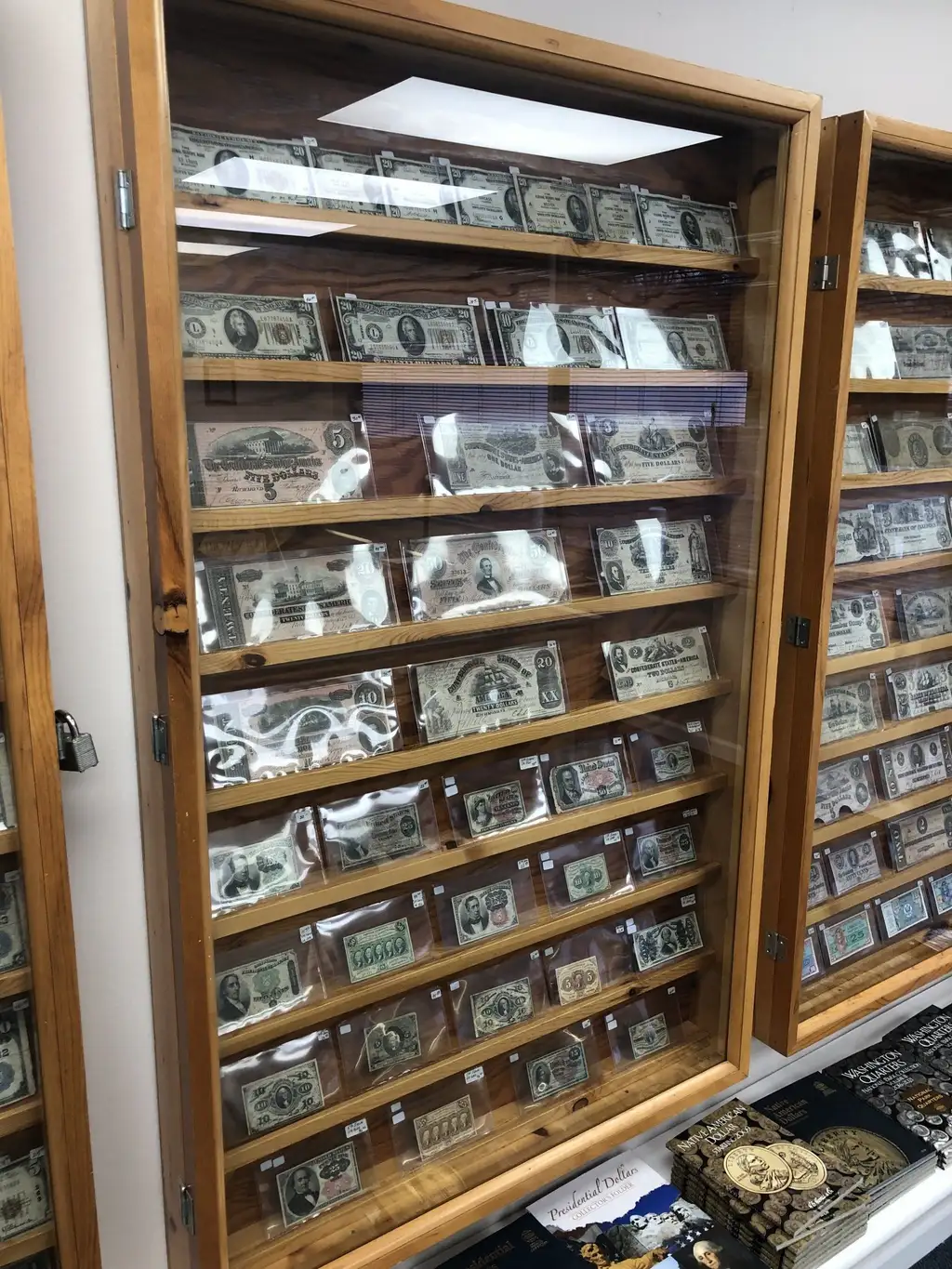
Wooden wall case of Confederate and fractional currency and 1934 Hawaii overprint notes at Kansas Coin Connection in Lawrence
What moves a note's value, and what does not
Paper money is judged on condition more than almost anything else. A note that has never been folded, with crisp paper, sharp corners and clean margins, sits in a different world from the same note after it has lived in a wallet. Folds matter, and so does how many: one light center fold is not the same as a note creased into quarters. Tears, pinholes, stains, ink marks and trimmed edges all count against a note.
After condition come the details printed on the note itself. The series, the signature combination, the seal color and the serial number can each change how much collectors want it. Low serial numbers, repeating digits and star notes draw extra attention. Then there is demand: a scarce note that few people are chasing can sit quietly, while a popular type with a long line of collectors behind it moves fast.
None of this can be settled from a photo or a text message, which is why the shop looks at notes in person. Dean can turn a note under the light, check the paper and tell you what is helping it and what is holding it back. That read is free and informal, and it comes with no pressure to sell.
Bring paper money flat, dry and just as you found it
Paper is fragile, and the damage people do with good intentions is permanent. Never tape a tear, because tape yellows, stains and cannot be taken off cleanly. Do not press a note under books or iron it flat, and do not try to erase marks or wash off dirt. A collector would much rather see honest wear than a note that has been improved.
The best way to carry notes is flat. An inert polyester sleeve of the kind sold for currency is ideal, and a clean folder or stiff envelope will do in a pinch. Keep notes away from rubber bands and paper clips, and out of damp basements and hot attics on the way to the counter.
If you have a whole collection, bring it together the way it came to you. Albums, envelopes and any little notes someone wrote on them are part of the story, and a set kept in its original order helps when Dean looks it over. Come Tuesday through Thursday between 10 AM and 5 PM, or call (913) 426-2567 to set a time on a Monday, Friday or Saturday, and he will take it from there at the counter in Lawrence.
“Great selection of coins and currency. Dean was very friendly and knowledgeable. I got some silver and a couple of older notes. Thank you!” Lee Zimbelman, from the shop's own reviews page.